The short answer
A garden-hose “pressure” nozzle works when the job is a rinse. It puts the water you already pay for into a shape you can aim: a fan for a patio, a stream for mud on a boot, a softer spray for leaves on a chair. That is useful every week of the year.
It does not work when the ad is selling you a pressure washer. A pressure washer is a machine with a pump. The pump is the whole product. A nozzle on the end of a hose has no pump. It cannot raise the pressure your city, your well, or your home’s plumbing already delivers. If a page, including a page about a nozzle we link below, calls that attachment a pressure washer, read the claim as marketing.
The distinction does not require a brand-by-brand gauge test. One tool adds energy. The other only organizes the flow.
A nozzle shapes water. It does not make pressure.
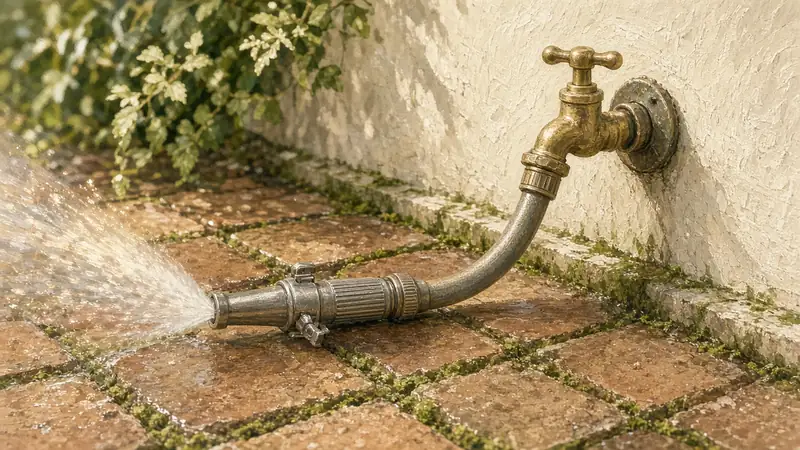
Open the spigot with no nozzle and the hose dumps a soft column. Thread a nozzle on and you ask the same water to leave through a smaller opening. The stream moves faster and it covers less ground. That is why it feels “stronger” in your hand, and why it knocks loose grit off a paver that an open hose only darkens.
Two limits travel with that trick.
First, you did not create new pressure at the spigot. Homes differ. A house at the end of a rural line, a house with an old galvanized run, or a spigot fed by a long, skinny, kinked hose will feel weak no matter how clever the tip is. A nozzle cannot repair the supply. If the un-nozzled hose already fills a bucket slowly, no attachment will behave like a washer.
Second, a faster stream is a smaller stream. You trade coverage for impact. That is the right trade for rinsing a chair leg. It is the wrong trade if you were hoping to strip a deck or cut through packed mud the way a rented washer does. People who are disappointed in nozzles are usually people who bought the trade without noticing it.
Distance matters as much as the setting. Impact falls off as you step back. A jet that stings your hand at six inches is a ordinary rinse at a few feet. Start farther away than you think, especially on wood, soft mortar, window screens, and anything painted.
What a focused hose stream is good at
Use the hose, with a nozzle you can shut off in your hand, for the mess that is loose.
- Patio and walkway dust, pollen, and the crumbs of a weekend. Wet it, and the film moves.
- Outdoor furniture before anyone sits down: a fan of water across mesh, slats, and cushions that are labeled as rinseable. Check the tag on a cushion before you soak the filling.
- Mud on boots, a dog’s paws at the back door, and tools that came in from the beds. A stream knocks the soil off so you are not carrying it inside.
- A car that is dusty rather than filmed with road grime. Rinse from the top down, then wash with a mitt if you actually need it clean. The nozzle’s job is the loose layer and the soap rinse, not the bonded dirt.
- Siding and windows, as a rinse after you have done the washing with a brush and a cleaner made for that surface. The hose takes the soap away. It does not do the washing. A machine that crawls the pane is a different tool: window-cleaning robots hold smooth glass with suction, and they still leave the frame to you.
On all of these, a shutoff at the nozzle is the feature that matters more than any “turbo” engraving. You can walk to the next chair without turning the spigot, and you are not watering the foundation while you move a pot.
The outdoor shelf now has a guide on portable evaporative coolers, which is a humidity question, not a rinse. The car and the grill-grate versions of this are still unwritten. The winter hose now has its own guide.
What still needs a brush or a real pressure washer
A nozzle is at its best on loose dirt. Some jobs still want a brush, a cleaner, or a pump, and that is useful to know before you start.
Moss and algae in a shady joint have roots, or at least a grip. Water slides over the green and leaves it. A cleaner meant for the paver, a dwell time, and a stiff brush do the work. Which bottle you mix is its own choice: cleaning tablets are one way to stop keeping a different spray for every room, and they still have to name the surface. The hose comes back at the end to carry the mess into the yard, not into the beds if you can help it.
Oil, rust stains, and barbecue grease are the same story. They are not dirt sitting on top. A focused rinse can cool a grate and carry away flakes you have already scraped. It will not dissolve a black patch on concrete. That patch wants a degreaser labeled for concrete, or, if you care about the result enough to rent a machine, a real pressure washer used on a setting that will not etch the slab. More water from a hose is not a gentler version of that machine. It is a different tool.
Paint prep, gum, and decades of gray on a deck are pressure-washer jobs or sandpaper jobs. Pointing a household jet at them until you are bored does not change the category. It only soaks the wall behind them.
Be careful with force even when you stay with the hose. A tight stream driven into a lap of siding, under a door, or at a screen can push water where the house did not want it. Wood fibers fuzz. Soft mortar joints lose sand. If the surface is older than the rest of the patio, believe the surface.
How to rinse a patio without a machine
This is the sequence that matches what a hose can do. It is not a product demo.
- Move the pots, the mat, and the toys. Sweep or blow the loose leaves first. If you spray that layer, you make mud, and then you have a second job.
- Choose a fan, not a needle, and stand back. Wet the area so the dust lifts instead of smearing.
- If the pavers are only dusty, the rinse may be the whole task. Work from the high side, or from the house outward, so the dirty water leaves instead of pooling against the foundation.
- If there is a film, algae shadow, or food stain, stop expecting the water to finish it. Use a cleaner that names your surface, give it the time the label asks for, scrub, and then rinse. The nozzle is the last step.
- Keep the stream moving. Parking a jet on one brick, one board, or one window screen is how a rinse becomes damage.
- Shut the nozzle off while you look. A hose left running “for a second” against a wall is a leak you are paying for.
When the patio is in full shade and stays damp, the green will return. That is a drainage and sunlight problem, not a nozzle problem. A future note on moss without a pressure washer is named on the outdoor shelf. The note itself is not a link yet.
When hard water clogs the tip
If the spray used to be even and now it spits, fans sideways, or dribbles from the swivel, look at mineral scale before you look at a new tool. Hard water leaves a pale crust in the tiny openings. Sediment from an older hose does the same thing, and it often shows up the week you use the hose hard after a winter in the garage.
A common household fix, and one nozzle makers often describe in their own care notes, is to take the tip apart if it is designed to come apart and soak the crusted pieces in white vinegar. Vinegar is an acid. It loosens the mineral film so you can brush it out of the holes with an old toothbrush and flush them. Leave it until the crust softens. There is no universal minute count, because the crust is not universal. Rinse the parts before they go back on the hose.
Read the fitting’s own note if it has a coating, a rubber seal, or a filter the maker says not to soak. Do not mix vinegar with bleach, and do not mix it with another cleaner “to speed it up.” If you move on to a labeled descaler because vinegar did not touch the crust, follow that label and only that label.
Before you blame the nozzle, flush the hose itself. Disconnect it, aim it at the lawn, and let it run long enough to push out the grit that has been sitting in the low spot. Then check the washer inside the fitting. A missing or cracked washer makes a connection that spits at your shoes and starves the tip. That feels like low pressure. It is a leak.
If you are on a well, or you already know the house has low pressure indoors, a nozzle will not invent what the plumbing does not have. The honest shopping question is then “which pattern still rinses at the pressure I have,” not “which nozzle is really a washer.” That narrower guide is named on the tools shelf and is not linked yet.
Where Jetterix fits
Jetterix is a hose-end attachment designed for a more focused jet on routine outdoor rinsing, without electricity and without a separate machine. It fits a standard garden hose, has an adjustable nozzle, and is built for patios, vehicles, siding, outdoor furniture, and tools.
That is the job this guide is about: a tighter, more useful stream from the hose you already own. Fan for broad rinsing. A tighter stream for the spots that need it. Shut it off between tasks.
We may earn a commission if you buy through our links, at no extra cost to you.
If you want the current package, price, and connector details, see the current Jetterix offer.
Pros and cons
Pros
- A focused hose stream rinses patios, chairs, tools, and siding without electricity or a separate machine.
- An adjustable nozzle gives you a fan for broad rinsing and a tighter stream for the spots that need it.
- It fits the hose you already own, so the upgrade is a simple fitting, not a new appliance.
- You can shut it off at the handle between tasks.
Good to know
- Spray strength follows your house’s water pressure. A good nozzle helps you aim that pressure well.
- A stiff brush still does the scrubbing on set-in dirt. The step-by-step guide to cleaning patio pavers with a hose puts the two together.
- Keep a tight stream moving, and ease off on soft wood or older mortar.
Who it’s ideal for
It is ideal for a homeowner who already rinses outdoor surfaces with a hose and wants a more useful stream for weekly dirt: pollen on a patio, mud on tools, soap off a car, a chair after a dusty week.
If you are refinishing a gray deck or lifting set-in oil on concrete, a rented pressure washer can be the extra tool for that day. For the regular rinse, a focused nozzle is the one that lives on the hose.
How to choose a nozzle
Buy, or keep, a nozzle you can shut off at the handle, that does not leak at the threads, and that still produces an even fan after a season. Patterns are the feature. A mist, a fan, and a stream cover the real week. Use a tighter “drill” or “turbo” setting only while you are moving, and only on surfaces that can take it.
If the nozzle in the bucket already sprays evenly, clean the tip, replace the washer, and unkink the hose first. When you want a more focused rinse, a new adjustable nozzle is a simple upgrade, and a brush that fits the paver still helps with the scrub.
A pressure washer earns its keep on a pump job: a deck you have decided to refinish, concrete with set-in oil, or siding you will rinse carefully according to the machine’s instructions. Renting for a day is often enough for that work. A focused hose nozzle is the everyday tool for pollen, dust, and a regular patio rinse.
The same split, a light everyday tool versus a heavier machine, shows up with clothes. The garment steamer and iron guide sorts which wrinkles a steamer can finish and which still want an iron.
The rest of the cleaning shelf will take the narrower jobs one at a time: pollen on furniture, vinyl siding, muddy boots. Those titles are listed as upcoming. They are not links until they exist.
Questions people actually ask
Is a garden hose nozzle a pressure washer?
No. A pressure washer adds a pump. A nozzle only narrows and aims the water your spigot already supplies. Ads that treat the two as the same thing are describing a wish, not the tool.
Will a nozzle remove moss or oil from pavers?
Not by itself, if the growth or the stain has set. A rinse lifts loose dirt. Moss, algae stains, and oil usually need a cleaner labeled for that surface, a brush, and time. A tight stream can help you rinse the cleaner off. It is not a substitute for the scrub.
Why did my nozzle start spraying sideways?
Mineral scale from hard water is a common reason a tip clogs or fans out in a ragged sheet. Sediment in an old hose does the same thing. Clearing the tip, and flushing the hose before you reattach it, is the first thing to try.
Does Jetterix need electricity?
No. Jetterix is a hose attachment that uses your home’s water. Whatever the fitting, the spray still depends on the pressure you already have.
Can I wash a car with only a hose nozzle?
You can rinse loose dust and rinse soap off. A nozzle does not replace a wash mitt on stuck-on film, and a tight jet held close to paint or a decal is a good way to cause damage. Keep the stream moving, and save the brush for the dirty parts.